
Date: 6 August 2026 Author: Bethany Brown
What happens when your physical activity festival meets a 37-degree heatwave? Here’s how we adapted, what we learnt and why the sector needs to start planning for a changing climate now.
Every year for the past 26 years, Energise Me has hosted the Hampshire School Games Festival. It’s changed a lot since its first event with its focus shifting from competition to participation, but this year brought a whole new challenge… a heatwave.
The festival usually attracts over 120 schools and over 1,200 children for a day filled with physical activity. Its purpose is to expose children to different ways of moving and create a positive early experience that means they may be more likely to have a life-long relationship with movement. We often have over 40 activities spanning multiple sites. Most of which happen outdoors on two open fields.
We have always been aware of warmer temperatures but haven’t faced the implications of extreme heat. With temperatures predicted to reach 37 degrees Celsius and a red heat health alert in place on the day of our event, we knew we needed to take action to keep children, coaches and our team safe.
We were still aiming to keep the event at its usual scale. We started activating our usual warm weather plan to make the day safer: more gazebos, extra water, ice lollies and plenty of reminders about sun protection. Because we had completed Sun Protection Accreditation a few years ago, we were able to share clear advice with schools and activity providers: build in extra breaks, reduce the intensity where needed, encourage children to listen to their bodies, and allow transitions between activities to take a little longer.
There was still a bit of uncertainty about whether the extreme weather would actually arrive. Let’s be honest – it’s British weather.
With the extreme weather warning continuing, that was the point when we realised we weren’t going to be delivering the event at full scale. As the government’s guidance came out advising people not to be outside between 11am and 3pm, we knew everything had to move indoors. We spoke to the Leisure Centre about capacity, air conditioning and temperature checks. Our Finance Officer, Carmen, was brilliant. In our activity allocation spreadsheet, she created a formula that meant every school had access to at least one air-conditioned room during the day.
The physical activity landscape is changing, and if we don’t change with it, our communities health – mental, physical and social – will be at risk.
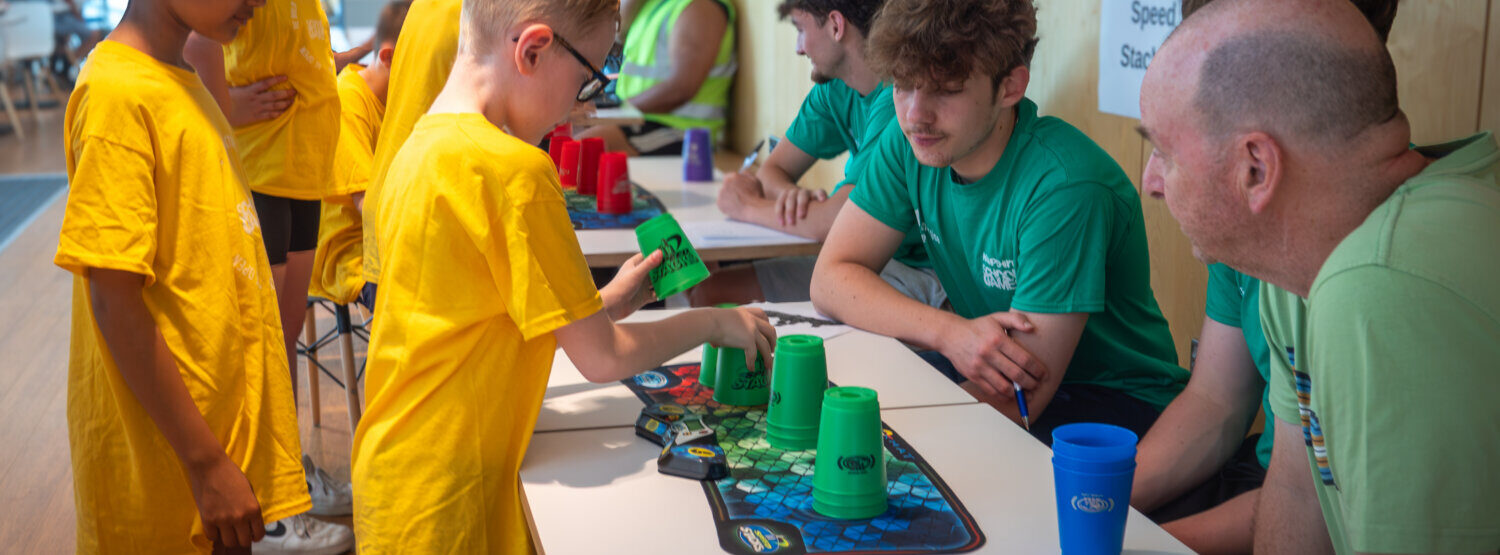
We made some deliberate decisions about which activities could safely go ahead. Speed stacking, for example, is a much lower intensity than something like rugby would have been. Where activities were higher intensity, we prioritised putting them in the air-conditioned spaces.
Once we knew what our new capacity looked like, we reached out first to schools in the areas with the highest levels of physical inactivity. Depending on the responses we received, we then decided whether to invite schools from other areas to take part.
We were also mindful that volunteers and activity deliverers would often be more static than the children, which brings its own risks in the heat. So, we made it clear: take breaks when you need them, and if you need someone to step in, come and speak to us.
On the day itself, we sent out fresh communications reminding everyone to take it at their own pace, stay hydrated and refill water regularly, and listen to children if they said they didn’t feel well. We also had medical teams on site to watch out and listen to children for signs of overheating.
Children had a great time! The smiles and laughter paralleled those of other years, their feedback said how much they enjoyed it, and even teachers admitted they would rather be at the festival than in their classrooms. So, despite the heat – and fewer numbers – we were still able to provide a positive early experience of physical activity. It just needed to look a little different.
Now we’re looking at whether June is the right month, whether it should be a series of smaller events across Hampshire, whether it will always be indoors going forwards, or if we get a marquee if we still want an outdoor element.
No matter where you are on your sustainability journey, there are plenty of resources available to help build your knowledge, confidence and ability to take action.
We decided to go ahead with the Hampshire School Games Festival because two years from now, three years from now, we are still going to have extreme weather events.
Across Hampshire and Isle of Wight, predictions include winter rainfall increasing by up to 35% by 2080 and an average temperature rise of 4 degrees Celsius during summer. We are going to have to adapt. For that reason, we need to start trialing and learning what works and what doesn’t so that future activity levels are protected.
We don’t share this to scare you, but it needs to be said. The physical activity landscape is changing, and if we don’t change with it, our communities health – mental, physical and social – will be at risk.
Having gone through this, we’ve come away with three big thoughts for the sector.
Heatwaves, flooding and other extreme weather events are already disrupting sessions, events and people’s ability to take part. That means extreme weather planning can’t be an afterthought anymore.
When we’re planning physical activity opportunities, we need to ask early: what happens if the weather changes? Can we move indoors? Can we reduce intensity? Can people still travel safely? Do we have enough shade, water, breaks and communication in place? Having those answers ready would prevent the last-minute alterations we experienced this year.
We were fortunate that the leisure centre had air conditioning and enough indoor space for us to adapt. But if that hadn’t been available, our options would have been much more limited.
As a sector, we need to think seriously about the facilities we rely on. Are they cool enough in summer? Are they safe and accessible during heavy rain or flooding? Do they support the needs of children, older adults, disabled people, volunteers and coaches in changing weather? If we want people to keep moving, we need the spaces around them to be ready too.
No matter where you are on your sustainability journey, there are plenty of resources available to help build your knowledge, confidence and ability to take action.
Sport England’s Every Move strategy aims to help the sport and physical activity sector become more sustainable, creating greater opportunities for people to get active both now and in the future.
You can find a wide range of practical guides, tools and resources to help reduce your environmental impact on the Sport England and Buddle websites.
If you don’t have an extreme weather plan that you can action when/if needed:

Helping us tackle inactivity to boost health and happiness